Monday, April 11, 2011

Blog #7 Biomes


Biomes or Ecosystems are the climate conditions on the Earth that we live in. Communities of plants and animals along with soil organisms are examples of ecosystems. The ecosystem includes 


   both abiotic and biotic factors. To tell apart the different ecosystems scientist use the factors, latitude like artic, boreal,temperate and subtropical or tropical. Humidity is another factor that scientist use to determine different ecosystems like seasonal variation: rain fall, a dry summer, and a wet winter. Another variation that determines a different type of Ecosystem is elevation, increasing elevation causes distribution of habitat types that is similar to increasing latitude.  Ecosystem are commonly called a prairie, savanna, or forest. In the forest ecosystem a common sight would be the plants, shrubs, and grasses. Leafy greens are a common sight in the forest ecosystem that also include animals such as microbes that live in the soil. Some other inhabitants of the forest ecosystem are the insects and spiders that help the decomposers of the forest. The consumers that are herbivores like rabbits and deer, deer is a common sight in the forest and could be seen grazing on the lush grass of the forest ground or on the leaves of some of the trees.  Other animals are raccons, possums, and preditors like coyotes and bears. Other preditors include bobcats and lynx that prey on other animals such as omnivores and smaller meat eatting animlas. Compared to the ecosystem of the Savannas there are alot of contrast between the two ecosystems, Savannas and forests.


In the Savannas the type of plant life that could be found are shrubs and isolated trees that are unlike the plants of the forest where the tree growth crowd the land. The floor of the savanna's are covered with rolling grass that are somewhat semi dry from the warm temperature that stretches year round. The two seasons of the Savannas are winter and summer. The winters are a long dry season while opposite from it is a long wet season that is summer. The animals found in the Savanna's habitat are animals that can survive the Savanna's harsh climate amoung these are birds like shrikes, hornbills, grey louries and green pigeons. Other animals include flycatchers, the knysna, purple-crested louries, rollers and raptors. The larger animals include the well known lions, leopards, cheetahs, and elephants. In addition there are also buffalos, rhinos, and hippos. Then there are the tall giraffes, the striped zebras, gazelles, kudus, waterbucks, and oryxes. But these are only some of the many animals to be seen in the Savanna's.



Monday, March 21, 2011

Blog # 6 Food Pyramid

 Of all the food groups, fruit, veggies, grains, dairy, and junks i think the most inportant would be the grains group.Not only because it is the bigest in the food pyramid but because it is estencial for humans to go through their daily lives. The other foods in the pyramid are also inportant and must be consumed also in order for the body to keep its normal growth and energy rate. I think the most important thing for humans besides water is energy. Without energy the human body wouldn't be able to go around doing all the necessities for the day. What a human's body needs is carbohydrates and in grains like bread, pasta, ceral, and rice are stocked full of the carbohydrates humans need. Another thing the human body needs is nutrients and protien that the grains also has. However grains doesnt have that many protiens as in dairy and fruits. So even though i think the most important group in the food pyramid is grains it is better if humans eat everything of the food pyramid except of course the junks group that are full of fats and oils. Still even the human body needs the junks to build other things needed for a human to go on throughout the day. It is always good to have a little of everything in your diet but too much of one thing is never good for your body so even though grains are good for you and even if junks taste good you shouldn't eat too much of it.
http://www.mypyramid.gov/
http://www.hsph.harvard.edu/nutritionsource/what-should-you-eat/pyramid/
http://en.wikipedia.org/wiki/Food_guide_pyramid

Thursday, March 3, 2011

Blog #5 Causes of Extinction

The five major extinction events in history was the mass extinction that took place at the end of the Ordovician where 60% of both terrestrial and marine life worldwide became extinct. In the late Devonian period enviorments that had nurtured reefs for a long time turned bad and the world once again fell in to a second mass extinction. The Permian mass extinction showed about 80-95% of marine species went extinct and the reefs didnt appear for millions of years. In the Triassic mass extinction about half of the marine invertbrates went extinct and 80% of land quadrupeds went extinct. Futhermore, in the end of the Cretaceous mass extinction 65 million years ago caused the widely know extinction of dinosaurs. Not only that almost on large land animals survived and plants where also affected. Now it seems humans are causing the 6 great mass extinction. It is because of the growing population of humans that are pushing some species into enviorments they aren't adapted to causing them to be hunted and eventually becoming extinct. Besides that the main cause is the changing climate which is caused my humans waste products and green house gases or known as global warming. With global warming the ice caps are melting which will eventually cause the sea level to rise like in the 5 mass extinction when sea level rised and many land animals went extinct.

Thursday, February 24, 2011

Blog #4

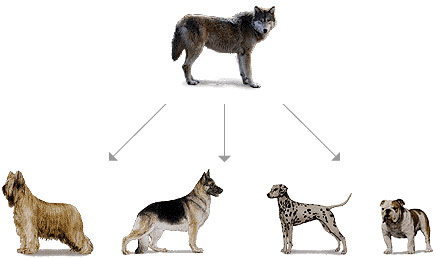
 Directional selection is a mode of natural selection in a phenotype that is single and favored. Making the allele frequency continuously move in one direction. Stabilizing selection also know as ambidirectional selection a type of natural selection where genetic diversity is decreased because the population slowly stabilized on a particular trait value. Another name for disruptive selection is diversifying selection, this is because it describes the changes in the populations genetics where extreme values for a trait are favored over intermediate values. Unlike stabilizing selection, disruptive selection the varity of the trait is increased and the population divides into tow distinct groups. To make the distinction between the three types of selections, here is an example of stabilizing selection. The weight of a newborn human if too light lose heat rapidly and tend to get infectious diseases. It also works the other way around, if the baby is too heavy they endanger not only themselves but also their mothers when passing through the birth canal. To help stabilize the birth weights a small range of birth weights had been selected to assure the stabilization. A good example for directional selection is the breeding of the greyhound dog. Breeders had selected from a group of hounds that were the fastest and then from their offsprings they selected again the fasted hound. It soon became a dog who could run up to 64km. The fur color of rabbits is a good example for disruptive selection. This rabbit has a incomplete dominance between white and black, now if the rabbit was to live in a enviorment with black and white rocks then the rabbits that would survive would be the black and white furred rabbits. However the gray furred rabbits that stand out and are unable to blend into their enviorment would be likely eaten which is when disruptive selection comes in. To ensure the species survival the selection allows only black and white fur to be showed but not the gray since it would decrease the species rate of survival.

Blog #3 Microevolution

Microevolution is the change in the gene frequency within a population or species. Microevolution occurs in four different ways. The first way is mutation, next is natural selection or artificial selection. In addition another process is gene flow and a genetic  drift. Microevolution is the result from small specific genetic changes that can lead to a new subspecies. Microevolution occurs usually when there is a environmental change. It occurs so that a species has some differences or sometimes creating a new species. This is because the environment is changing so the species need to adapt along with the changing climate. In the movie the Future is Wild the modern day animals evolve into a different animal completely so that they can survive in the changed climate and environment.   answers.yahoo.com/question/index?qid=20090920160125AA1tK3Uhttp://en.wikipedia.org/wiki/Genetic_variation
http://en.wikipedia.org/wiki/Microevolution

Thursday, February 17, 2011

Blog #2 Fossil Records


Fossil records tend to hard to interpret because they are vague. A fossil can only form if the organism or animal had a skeletal body. If the organism doesnt have a skeletal body then there wouldn't be a fossil since the parts that form a fossil are usually the bones or hard and solid parts of the body that dont decompose over time. Also many things that happen in nature can damage the fossil making the record incomplete, and though it still gives us some information about the creatures that existed on earth long before us sometimes it is useless.  This makes fossil records are hard to explain because so many of the other fossils are lost or have been erased from the face of the earth by erosion and even becoming the sediments. Not only that fossil dont give us that much information about the organism. Fossils give us information about what the organism may of looked like as in shape and size but how about what color their skin or fur looked like? Fossils have no way of telling us about that. In addition there is also that problem of whether the fossil is real or not. Whether the fossil has reached all the requirements of being a fossil, like being old enough.
                                                         http://en.wikipedia.org/wiki/Fossil
http://answers.yahoo.com/question/index?qid=20080312052712AASeKXV
http://hoopermuseum.earthsci.carleton.ca/evolution/g.html

Thursday, February 3, 2011

Blog # 1 Theory

The main reason Evolution isn't a law is because it cannot be repeated and get the real results. Evolution is the change over time. In this case evolution changes an orgainism such as a finch. The finche's beakes changed over a time period so that it could survive more easily in the changed enviorment. Evolution happens to orgainism and animals because of an enviormental change like a decrease in food or maybe an earthquake. Mostly its because the normal cycle for an animal or orgainism had changed so it has to adapt or die out. This process is called natural selection-change so that a species wouldnt die out. Another
reason evolution isn't a law because it hasn't been observed and still hasn't been able to be proved.                                                                       http://en.wikipedia.org/wiki/Evolution
http://www.darwins-theory-of-evolution.com/